By: Edson Nagamachi
Today’s recommendation is a TV series that illustrates quite precisely how improvements are implemented after a major operational problem is identified, the cultural barriers to implementing and sustaining a process after a change, and how leadership and those involved put some of the principles of Lean/TPS into practice.
The series is GATE 24: THE BORDER, a Japanese production by TV Asahi, available on Netflix.
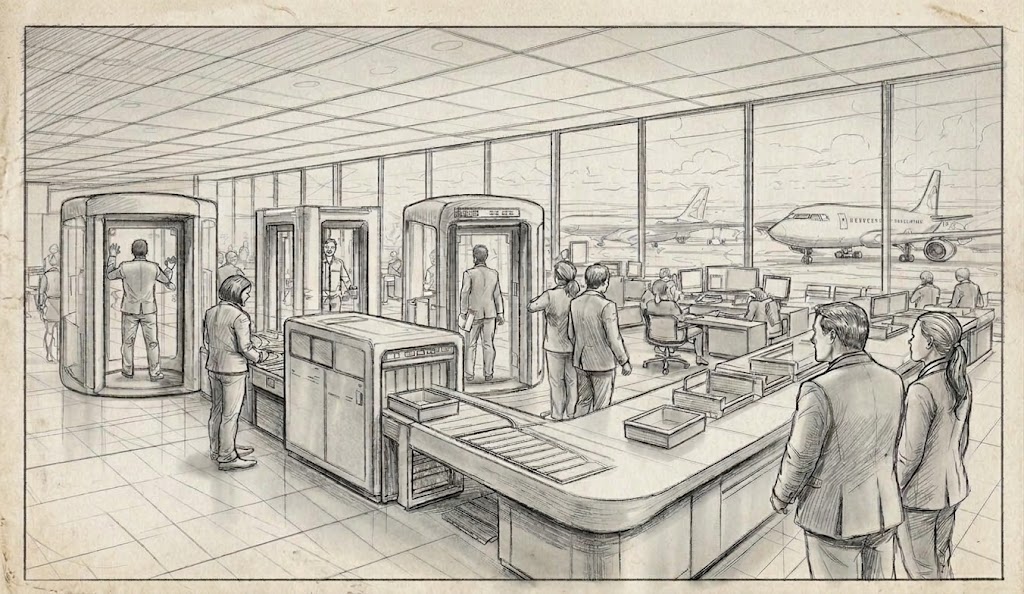
The plot addresses a real crisis currently facing major international airports in Japan due to the significant increase in the number of foreign tourists, which puts border control processes under strain and causes them to collapse. The story takes place at a fictional airport, Kanto International Airport, a hub that receives a large volume of charter flights.
A preliminary analysis by the authorities revealed that the lack of an integrated and efficient flow between the Immigration, Customs, Port Authorities, and Police departments caused passenger congestion, resulting in widespread delays and chaos at airports.
Although it is a crime drama, the series serves almost as a case study of the challenges involved in applying Lean thinking and practices outside the traditional factory floor. The plot revolves around a newly established interministerial cross-agency task force, bringing together customs officers from the Ministry of Finance, immigration control officers from the Ministry of Justice, and police security personnel in a high-volume, high-stakes environment. The goal is to eliminate waiting across multiple queues and optimize passenger flow in a remote building called GATE 24.
1. Genchi Genbutsu (現地現物) and the Power of Careful Observation
The protagonist, customs inspector Machi Mori, does not make decisions based solely on previous intelligence reports or computer screens. Her effectiveness comes from her habit of going directly to the exact point in the process. She observes objects, luggage, passengers’ physical reactions, and subtle deviations in the conveyor belt routine firsthand.
The plot emphasizes that data and reports only tell us what has been recorded, while the GENBA reveals reality. For Lean practitioners, Mori’s approach embodies Ohno’s chalk circle principle: staying at the workplace and observing until the root cause of a problem is identified, rather than assuming solutions from a distance.
2. Jidoka (自働化) and the Courage to Stop the Flow (Andon)
At a major airport, the continuous flow of passengers and luggage is an operational priority. Any stoppage creates queues, connection delays, and extremely high costs.
On several occasions, Mori and her colleagues detect subtle abnormalities and make the unpopular decision to pull the Andon: stopping the clearance of a group of passengers or launching a targeted investigation, even under hierarchical pressure to keep the conveyor belt moving.
The lesson is clear: allowing a defect to move downstream or, in the context of the series, letting contraband or a threat pass in order to meet a productivity target can be far more costly in subsequent process stages. Stopping to contain the problem at its source is the essence of Jidoka.
3. JKK (Ji Koutei Kanketsu / 自工程完結) and Breaking Down Departmental Silos
At the beginning of the series, GATE 24 suffers from the classic bureaucratic problem of functional silos: Immigration argues that its work is limited to passports and visas; Customs focuses solely on the contents of luggage; and the Police wait for orders before acting in criminal cases.
This passing of responsibility creates gaps precisely at the handoff points between processes.
As the plot progresses, the team only succeeds when it adopts the JKK approach, which means ensuring quality within each process. Each stage assumes full responsibility for not accepting faulty information, not making errors of judgment, and never passing a risk or defect on to the next agency. The process only becomes fluid when the focus shifts from defending one’s own jurisdiction to managing the entire value stream.
4. Visual Management (Mieruka / 見える化) and Standardized Work
The storyline directly contrasts career civil servants who operate strictly according to bureaucratic manuals with the need for procedures that genuinely reflect changing conditions in the field.
Standardized Work is presented not as a rigid, static office regulation, but as the necessary foundation for detecting abnormalities. Without a clear standard for how a legitimate entry flow should operate, it becomes impossible for officers to immediately identify what is out of standard (Mieruka).
5. Hitozukuri (人づくり) and Developing People to Solve Problems
The initial group consists of individuals considered misfits or discarded by other departments. However, the task force’s leadership and dynamics do not attempt to turn everyone into identical robots. Instead, they develop each member’s critical thinking and investigative abilities.
The team’s true development takes place through the continuous practice of PDCA in response to security failures and real incidents. This demonstrates that no screening or X-ray technology can replace the trained eye of people who are equipped to think and solve problems at the source.
Here’s the recommendation: watch the series and try to identify the Lean/TPS concepts woven into the storyline. And who knows? You might even recognize situations you have experienced in your own company. After all, the setting may change, but many of the challenges involved in improving processes and developing people are remarkably familiar!
Edson Nagamachi
Senior Managing Director of Honsha for Latin America. A metallurgical engineer who graduated from the Polytechnic School of the University of São Paulo (USP) and holds a specialization in Business Administration from FGV, he built a career spanning nearly 30 years at Toyota do Brasil, working in Production Engineering, Production Control and Logistics, Project Management, new plant implementation, and Innovation & Industry 4.0. He was directly involved in implementing the Toyota Production System in Latin America and establishing strategic structures such as Obeya and e-kanban.
Today, at Honsha, he is dedicated to helping organizations develop operational excellence with purpose, sustainability, and a positive socioeconomic impact.
Additional links
Visit the Honsha website:
https://www.honsha.org/?lang=pt-br
Read more articles about Lean and Toyota at Honsha: